First aid training for companies: what to cover and how to run it
Łukasz Kamiński5 min read
First aid training for companies teaches employees what to do in the first minutes after an accident or a sudden cardiac arrest, before the ambulance arrives: how to check that the scene is safe, call for help, perform CPR, use an AED and stop severe bleeding. It works best when every participant performs these steps themselves at least once, rather than watching someone else do them.
This article describes the rules that apply in Poland. If you operate elsewhere, check your local requirements; the content of a good training session is largely the same.
Legal basis for first aid at work in Poland
Labour Code, Article 209¹: the employer provides the means needed for first aid and designates employees to give it. The number of these people, their training and equipment must reflect the type and scope of the business, the type and level of hazards, and the number of employees and other people on the premises.
Health and safety training: the framework programmes in the regulation on health and safety training include first aid, among other places in the part on what to do after an accident and in emergencies. Intervals and scope of periodic training are covered in our article Periodic health and safety training in Poland: how often.
So the law does not say “train this many people”. It says: match the number of people and their preparation to what can realistically happen in your workplace.
What first aid training should include
Scene safety: before anyone approaches the casualty, they need to check they are not walking into danger themselves: electricity, a moving machine, a chemical, forklift traffic.
Talking to the 112 dispatcher: what to say, in what order, when not to hang up. Under stress this is one of the hardest parts, and it can be practised.
BLS (Basic Life Support): checking responsiveness and breathing, calling for help and chest compressions according to the current European Resuscitation Council (ERC) guidelines.
AED: where the defibrillator is in your building, how to switch it on, how to place the pads and what to do when the casualty is lying in water or on a metal surface.
Severe bleeding: direct pressure, a pressure dressing and situations where you have to act faster than with an ordinary wound.
Wounds and burns: dressing wounds, cooling thermal burns, dealing with chemical burns with reference to the safety data sheets for substances used in your company.
Recovery position and handover: how to position an unconscious person who is breathing and what to tell the paramedics when they arrive.
It helps when part of the content is tailored to the workplace. Access to an AED looks different in an office than on a production floor or in a warehouse with high-bay racking.
How to organise first aid training in a company
Start with the hazards. Your occupational risk assessment shows which injuries are most likely: cuts, burns, electric shock, falls from height. That sets the scope of the training and the number of people designated to give first aid.
Match the number of people to reality. Take shifts, holidays, several buildings or remote workstations into account. One trained person for the whole company will not help if they work a different shift or at the other end of the site.
Look after equipment and signage. First aid kits, the AED, first aid points and the list of designated people must be where an employee will look for them under stress, not only in the paperwork.
Repeat the practice. Knowledge from one course stays, but confidence in CPR movements fades quickly. Short, regular refreshers work better than one long session every few years.
Do not leave the rest of the team unprepared. Designated people are the minimum. Anyone can witness an accident, and the first seconds depend on who is standing closest.
Hands-on practice in VR: every participant saves a life themselves
A typical session has one manikin and a group of people. A few practise, the rest watch, and hardly anyone really goes through the call with the dispatcher.
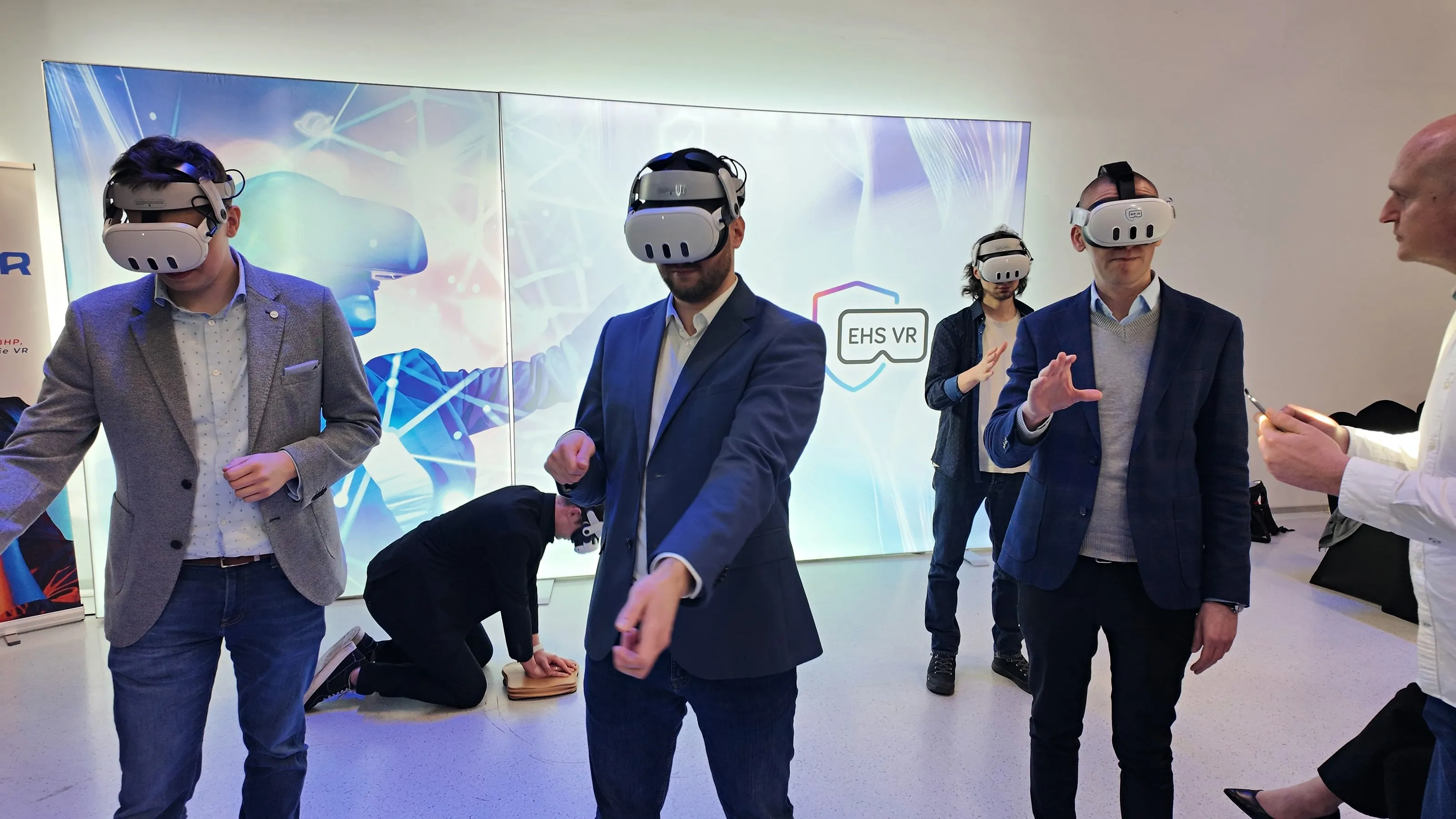
In a VR headset every participant goes through the whole scenario alone: checks the scene, talks to the dispatcher (the app recognises speech), performs CPR and uses the AED. They can repeat the scenario as many times as they need until they act with confidence. At the end they get a score with an analysis of their mistakes, and you see the report, saved anonymously or in the participant’s profile.
Apps that fit first aid training at work:
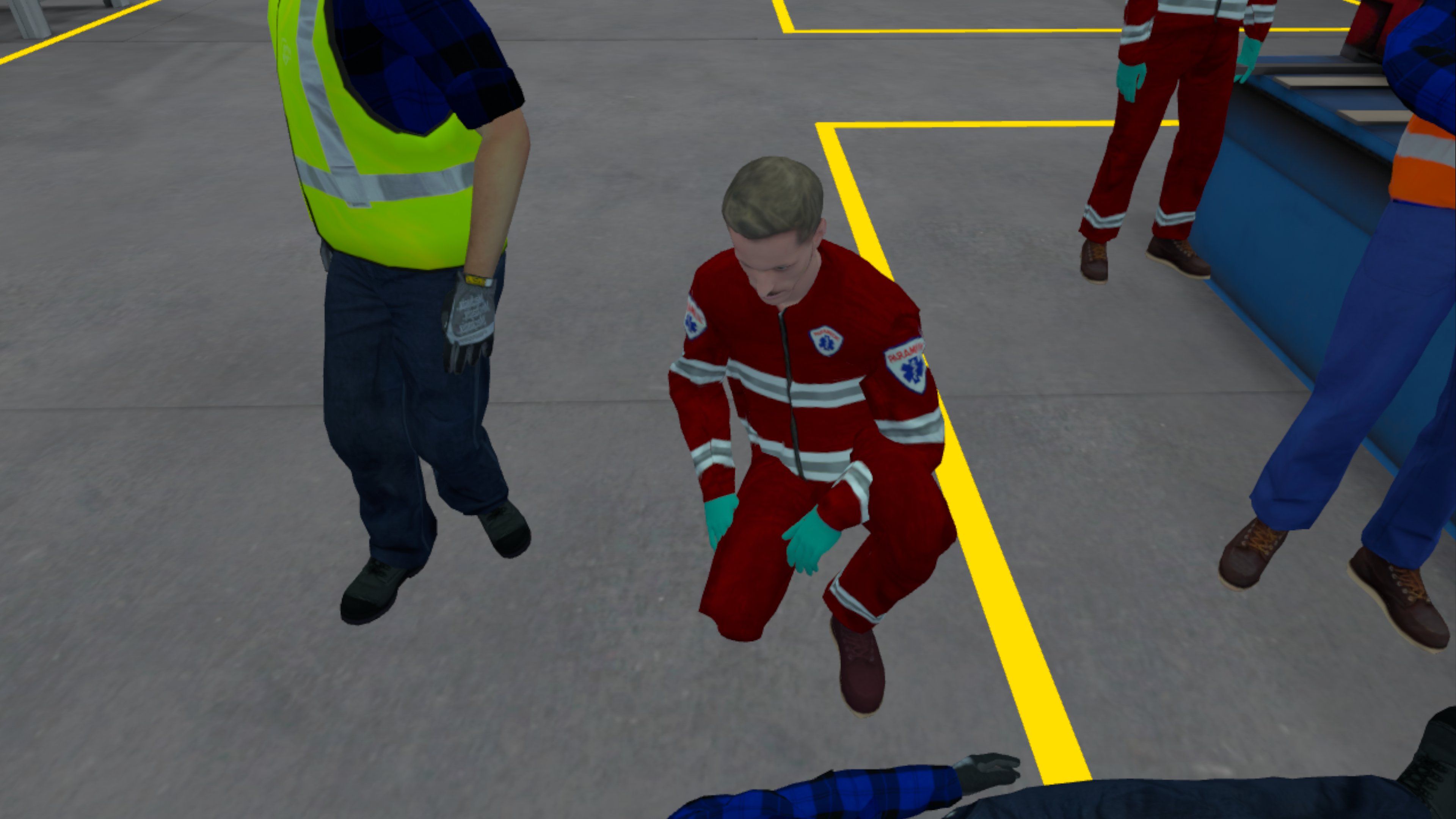
BLS & AED in the Factory VR Training: an unconscious worker on the factory floor, hazard assessment, CPR, AED, working in a rescue team and a test with distractions.
BLS Solo Training in VR: CPR and AED alone, when no one else can help. It works with any training manikin, so compressions are done on a real manikin.
VR does not replace a manikin or a paramedic instructor where a certified course is required. What it does give is something most sessions lack: a moment when every employee goes through a rescue from start to finish themselves, rather than only hearing about it.
Do companies have to train employees in first aid?
In Poland, the Labour Code (Article 209¹) requires the employer to provide the means for first aid and to designate employees who will give it. Their number, training and equipment must reflect the type and scope of the business, the type and level of hazards, and the number of employees and other people on the premises. First aid is also part of the framework programmes for health and safety training, as described in our article on periodic health and safety training.
How many employees should be trained in first aid?
Article 209¹ of the Polish Labour Code does not set one number for all companies. The number of designated people should reflect, among other things, the hazards and the number of employees and other people on the premises, so in practice you look at the occupational risk assessment, the number of shifts, the layout of your buildings and how quickly help can reach every workstation.
Does VR first aid training replace a course with a paramedic?
No. Where a certified course or manikin practice with an instructor is required, VR does not replace it. It adds what is usually missing: every participant goes through the whole scenario themselves, including CPR and the AED, and can repeat it.
Can you practise chest compressions on a manikin while wearing a VR headset?
Yes. BLS Solo Training works with any training manikin, so the participant sees the scenario in the headset and performs compressions on a real manikin.
How often should first aid training be repeated in a company?
The Polish rules cited in this article do not set a separate interval for first aid training. First aid comes back at every periodic health and safety training, and practical skills are worth refreshing more often, because without practice they fade quickly.
Hatches, ventilation, atmosphere measurement, entry and evacuation in a VR headset: what confined space VR training practises and where real training takes over.
Fire, first aid, high-risk work, hazard identification and LOTO in a VR headset: what VR health and safety training covers, where it helps and where it stops.
With your consent we use cookies and similar tools from Google, Microsoft Clarity and Meta to measure traffic, see how the site is used (heatmaps and session recordings with form fields hidden) and improve our ads, and we load the Pipedrive chat. You decide: the site works fully without them. Privacy policy
 Łukasz Kamiński